Summary
Across the global process industries, sampling remains one of the most operator-intensive and safety-critical routine tasks in plant operations. Every day, thousands of plant technicians manually connect sample cylinders to process taps, open isolation valves, fill containers with hazardous gases or liquids, and disconnect — often using decades-old connector designs that provide no engineered protection against cross-threading, atmospheric contamination, or accidental release. The result is not just a safety risk, but a systematic quality problem: studies of refinery and chemical plant analytical data show that 15-30% of out-of-specification quality results trace back to sampling error rather than actual process deviation. A new generation of engineered sampling connector systems — integrating double-block-and-bleed valve configurations, self-sealing quick-connects, and cylinder-specific CGA pigtail assemblies — is fundamentally changing the economics of industrial sampling by eliminating the most common failure modes at the connector level.
Part 1: The Hidden Costs of Legacy Sampling Connectors
Traditional sampling setups typically consist of a needle valve or ball valve at the process tap, a length of tubing or flexible hose, and a sample container with a basic CGA or NPT connection. This configuration has remained essentially unchanged for decades, and its limitations impose four categories of hidden costs:
Operator safety exposure is the most visible cost. Every manual connection and disconnection of a sample cylinder at an open process tap creates a window of potential exposure to toxic, flammable or asphyxiating gases. Even with purging protocols, residual process fluid in the connector dead volume can release upon disconnection. Industry incident databases consistently rank manual sampling operations among the top five causes of reportable personal exposure events in chemical and refining facilities.
Sample contamination and non-representative results are the most expensive cost, though difficult to attribute directly to connectors. Atmospheric oxygen and moisture ingress through loose NPT threads, previous sample residue trapped in connector dead legs, and reactive connector materials that alter sample chemistry all produce analytical data that does not represent actual process conditions. A single contaminated sample triggering an unnecessary process adjustment — a catalyst feed rate change, a distillation column reflux modification, or a product blend correction — can cost tens of thousands of dollars in yield loss before the error is detected.
Regulatory non-compliance risk increases as environmental agencies tighten fugitive emission monitoring requirements. Connectors classified as potential leak sources under LDAR (Leak Detection and Repair) programs must be monitored, documented and reported. Legacy threaded connections that cannot demonstrate consistent leak-tight performance accumulate compliance liabilities over time, particularly in facilities subject to EPA Method 21 or EN 15446 monitoring protocols.
Operational inefficiency compounds across thousands of sampling events. Cross-threaded CGA connections require connector replacement. Stuck fittings require maintenance intervention. Incompatible materials require connector inventories for multiple gas types. What appears as a minor inconvenience per event becomes a measurable drain on maintenance resources when summed across a plant’s annual sampling volume.
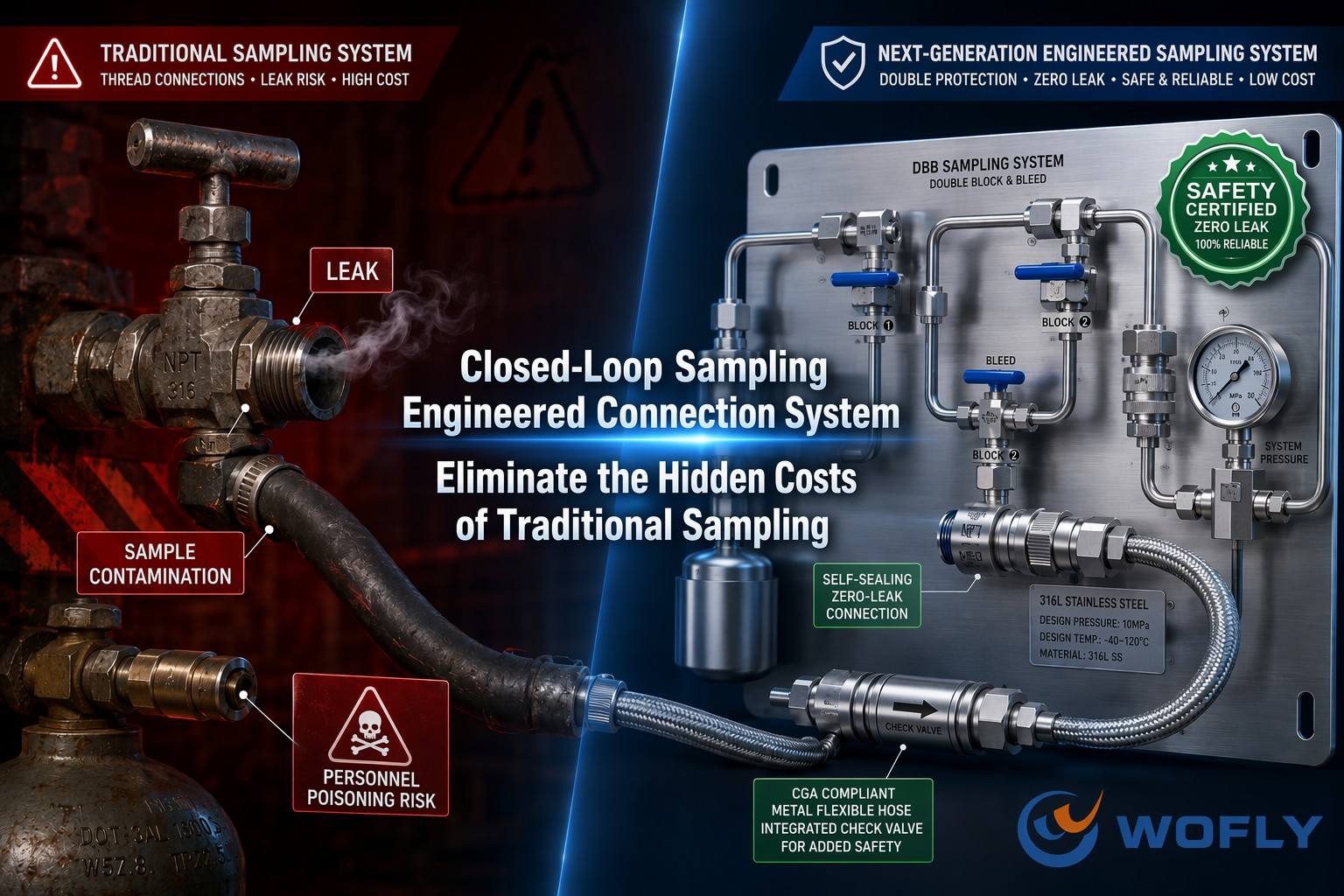
Part 2: The Engineered Connector Systems That Are Changing the Standard
Three connector system architectures have emerged as the new best practice for industrial sampling, each optimized for a specific operating environment:
Integrated double-block-and-bleed (DBB) sampling panels represent the gold standard for hazardous process sampling. The DBB configuration places two isolation valves in series at the process tap, with a bleed valve between them. During sampling, the first block valve opens to fill the inter-valve cavity. It then closes, the bleed valve vents the cavity to a safe location, and the second block valve opens to deliver a fully isolated sample. Connectors in DBB systems are typically all-welded or double-ferrule SS316L compression fittings — no threaded NPT connections that can loosen or leak over thermal cycles. The bleed function eliminates the operator exposure window entirely, since the sample cylinder connects and disconnects from a depressurized, purged cavity.
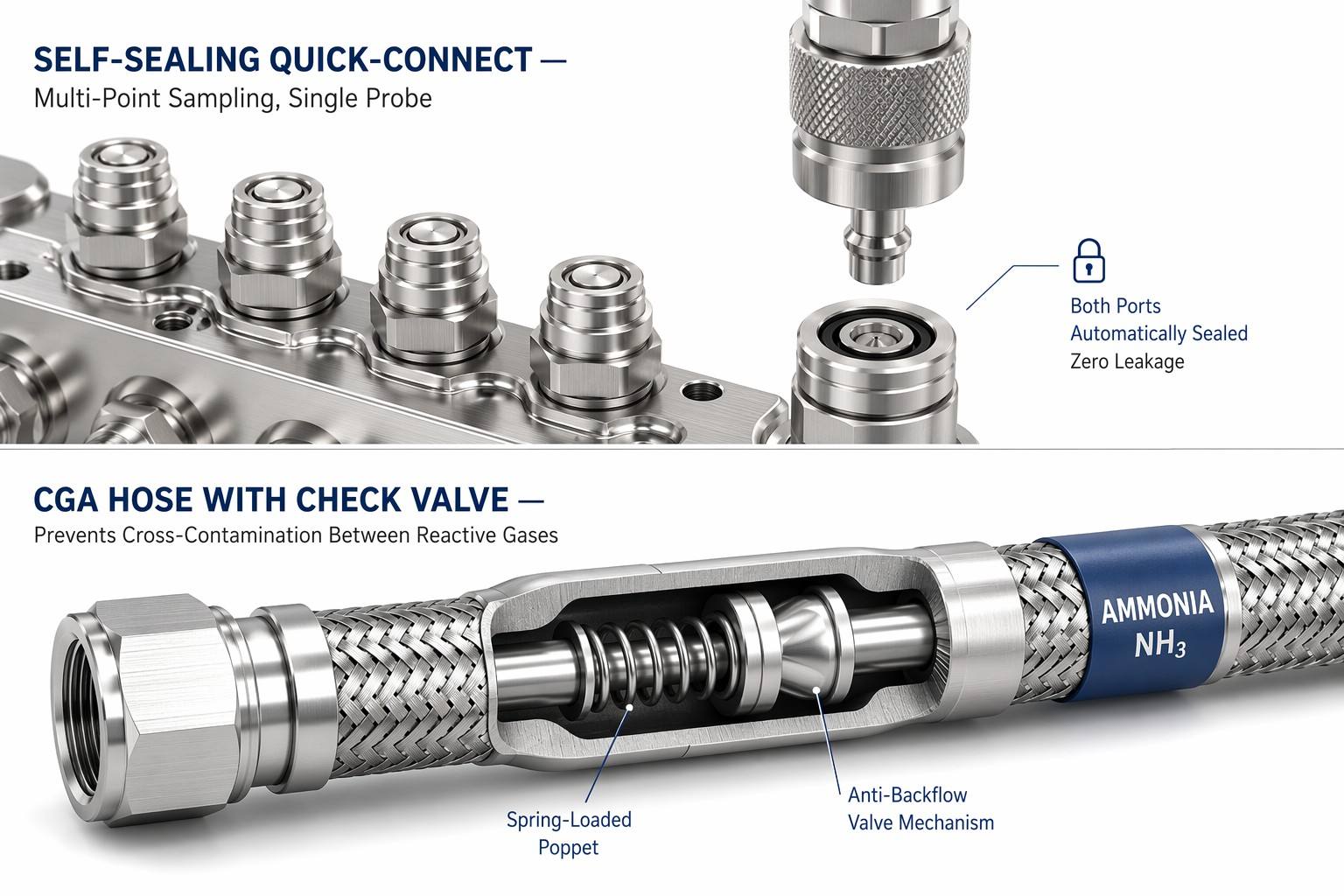
Quick-connect sampling panels with self-sealing couplings are the preferred architecture for multi-point sampling where a single portable analyzer or sample cylinder serves multiple process taps. Each tap is equipped with a panel-mounted female quick-connect body that seals automatically upon disconnection. The operator carries a single male quick-connect probe attached to the analyzer or cylinder, connecting sequentially to each sampling point. This architecture eliminates the need for individual CGA connectors at every tap, reduces connector inventory, and standardizes the connection procedure across all sampling points — reducing operator training burden and procedural error risk.
Cylinder-specific pigtail assemblies with integrated check valves address the most persistent failure mode in gas sampling: cross-contamination between incompatible gases. A CGA pigtail is a short, flexible connection assembly that adapts the cylinder’s CGA outlet to a common manifold fitting. By dedicating each pigtail to a specific gas type and integrating a check valve that prevents backflow, the sampling system prevents the accidental mixing of reactive gases — such as oxygen and hydrogen, or ammonia and chlorine — that can occur when a cylinder is connected to the wrong manifold port. For facilities sampling multiple gas types, dedicated pigtail assemblies are the lowest-cost insurance against a potentially catastrophic cross-contamination event.
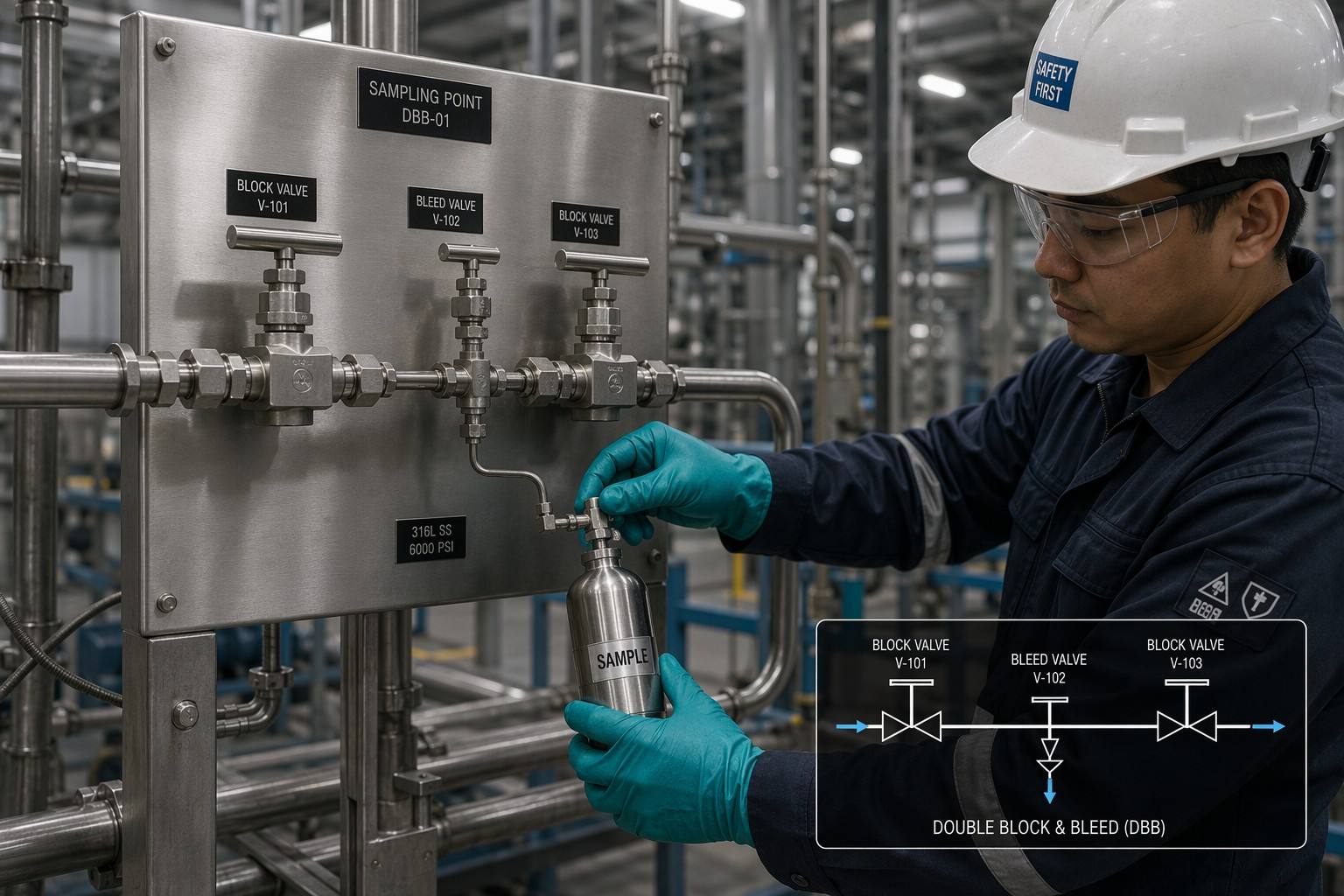
Part 3: Implementation Considerations for Facility Engineers
Transitioning from legacy threaded connectors to engineered sampling connector systems requires upfront investment, but the operational payback is measurable across four dimensions:
Safety incident reduction is the most immediate return. Facilities that have replaced open-process-tap sampling with DBB panels report near-elimination of sampling-related personal exposure events. The connector is the engineering control — it eliminates the hazard at the source rather than relying on personal protective equipment to manage the risk.
Analytical data quality improvement produces the largest financial return, though it is the hardest to attribute to connectors specifically. Facilities that have implemented zero-dead-volume connector designs and electropolished SS316L wetted surfaces in their sampling systems report 40-60% reductions in unexplained out-of-specification quality results within the first year. When analytical chemists and process engineers no longer question whether a result represents the sample or the sampling system, the entire quality control workflow accelerates.
Maintenance workload reduction is the easiest return to measure. Threaded connections require retorquing. Quick-connects with O-ring seals require periodic replacement. Compression fittings, once properly installed, require no routine maintenance beyond visual inspection. The labor savings alone often justify the connector upgrade within 18-24 months for facilities with high sampling volumes.
Regulatory compliance documentation becomes dramatically simpler with engineered connector systems. Welded and compression fitting connections do not classify as potential leak sources under most LDAR programs, eliminating thousands of monitoring points from the compliance calendar. For facilities subject to EPA MACT standards or EU IED reporting, reducing the count of monitored connections directly reduces compliance overhead.
Conclusion The connectors and fittings in an industrial sampling system may represent less than 5% of the total instrumentation budget, but they determine 100% of the sample quality and a disproportionate share of operator safety risk. As process industries face tightening safety regulations, growing analytical data integrity demands, and persistent pressure to reduce operating costs, the transition from legacy threaded connections to engineered connector systems is emerging as one of the highest-ROI instrumentation upgrades available — not because connectors are expensive, but because the costs of keeping bad ones are far higher.
Media Contact & Company Profile
Shenzhen Wofly Technology Co., Ltd. manufactures a comprehensive range of industrial fluid system components for sampling applications, including SS316L double-ferrule compression fittings, CGA pigtail assemblies with integral check valves, self-sealing quick-connect sampling couplings, and integrated grab sampling panels. The AFKLOK product line supports gas and liquid sampling in chemical, petrochemical, semiconductor, pharmaceutical and laboratory environments worldwide. For sampling system audits, connector compatibility assessments or panel configuration proposals, contact the AFKLOK Fluid Systems Engineering Team at www.szwofly.com.
Post time: Jul-23-2026