Summary The global semiconductor industry is racing toward sub-3nm nodes, 300mm wafer scale-up and gigafab expansion — yet the most critical safety system in every fab operates entirely out of sight. Beneath the pristine cleanroom floors, in the sub-fab utility level, rows of dry scrubbers silently process toxic, corrosive and pyrophoric exhaust gases generated by every etch, deposition and implant tool. Without these systems, a single silane leak or arsine breakthrough could trigger an immediate fab evacuation. As process technologies grow more chemically aggressive — with higher gas flows, new precursors and tighter emission regulations — point-of-use dry scrubbing has evolved from a compliance checkbox into a strategic fab infrastructure investment. Shenzhen Wofly Technology, with 15 years of gas system engineering expertise, delivers the D-200S dry scrubber as a purpose-built answer to the semiconductor industry’s escalating exhaust abatement requirements.
Part 1: The Chemical Reality of Semiconductor Manufacturing — What Happens After the Process Chamber
To the outside observer, semiconductor manufacturing appears as rows of automated tools operating in silent, particle-free cleanrooms. The reality beneath the raised floor is chemically intensive. Every major process step generates exhaust streams that cannot be vented untreated:
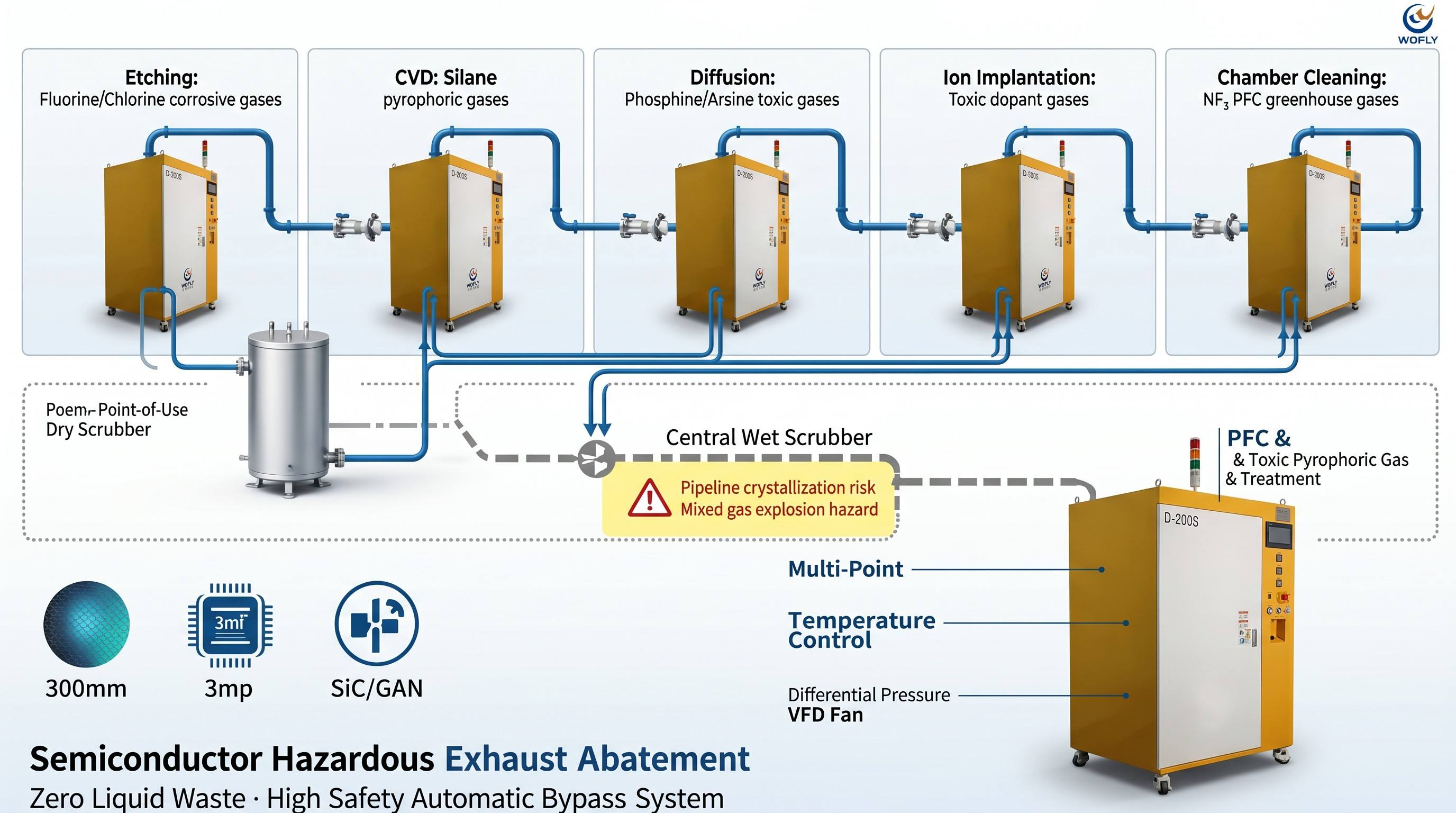
Etching — whether dry plasma etch or reactive ion etch — consumes fluorinated gases (CF₄, CHF₃, SF₆, NF₃) and chlorine-based chemistries (Cl₂, BCl₃) to selectively remove material layers. The exhaust carries unreacted process gases, volatile etch byproducts, and halogen compounds that are simultaneously toxic and corrosive. A single etch chamber running a high-aspect-ratio silicon trench etch can exhaust over 100 SLM of mixed hazardous gases.
Chemical Vapor Deposition (CVD) and PECVD use silane (SiH₄), ammonia (NH₃), and tetraethyl orthosilicate (TEOS) to deposit dielectric and passivation layers. Silane is pyrophoric — it ignites spontaneously on contact with air. Unreacted silane in the exhaust line poses a constant fire and explosion risk. Ammonia is both toxic and corrosive to downstream ductwork and abatement equipment.
Diffusion furnaces introduce dopant gases — phosphine (PH₃), arsine (AsH₃), boron tribromide (BBr₃) — that are among the most acutely toxic substances used in any industry. Arsine has an Immediately Dangerous to Life and Health (IDLH) concentration of just 3 ppm. Chamber cleaning cycles flush these residual dopants through the exhaust system in concentrated pulses.
Ion implantation uses the same dopant hydrides under high-voltage acceleration, creating additional exhaust challenges from beam strike byproducts and vacuum pump oil contamination.
Chamber cleaning processes — performed between every deposition cycle to prevent particle accumulation — flood the chamber with nitrogen trifluoride (NF₃) or hexafluoroethane (C₂F₆). These perfluorinated compounds (PFCs) have global warming potentials 7,400 to 23,900 times that of CO₂. While not acutely toxic, their atmospheric persistence and radiative forcing make them priority targets under the Kyoto Protocol, the Kigali Amendment, and national semiconductor industry PFC reduction agreements.
Each of these exhaust streams requires dedicated point-of-use treatment. Relying solely on central house scrubbers at the end of long exhaust duct runs creates unacceptable risks: reactive gases can condense, crystallize or react within the ductwork; incompatible gas mixtures can form explosive combinations; and a single tool’s exhaust upset can propagate through the common header to affect multiple process bays.
Part 2: The Engineering Logic of Dry Adsorption — Why D-200S Outperforms Legacy Approaches
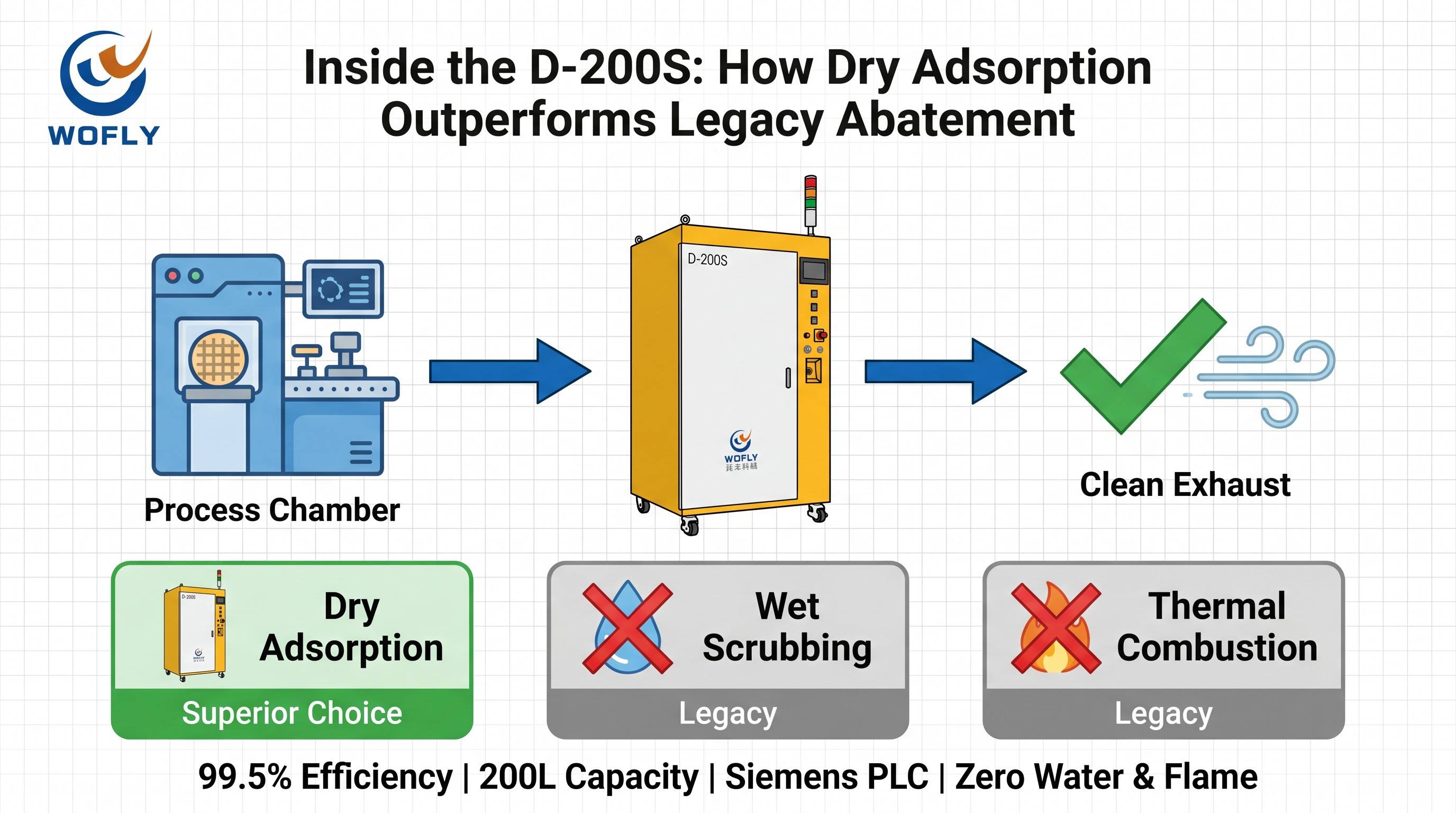
Three abatement technologies compete for point-of-use semiconductor exhaust treatment. Understanding their fundamental trade-offs explains why dry adsorption has become the dominant architecture for most process tools:
Wet scrubbers use water contact to absorb water-soluble gases (HCl, HF, NH₃) and neutralize acid streams. Their limitation is fundamental: gases like silane, arsine and phosphine are not water-soluble, passing through the scrubber essentially untreated. Wet systems also generate continuous liquid hazardous waste streams requiring on-site treatment or off-site disposal — converting an airborne hazard into a water pollution liability. In regions with strict wastewater discharge permits, this secondary waste burden can be the binding constraint on fab expansion.
Thermal-combustion abatement achieves high destruction efficiency across broad gas spectra by oxidizing exhaust at 800-1200°C. The trade-off is equally fundamental: introducing open-flame equipment into a sub-fab environment creates fire and explosion risks that multiply with every installed unit. Thermal systems consume 10-50 kW of electricity per unit continuously and generate nitrogen oxides (NOx) as a secondary pollutant. For facilities targeting carbon neutrality, the energy consumption alone makes thermal abatement difficult to justify at scale.
Dry chemical adsorption addresses both sets of limitations. The D-200S operates at ambient temperature with no combustion, no water circulation, and no liquid waste generation. Process exhaust enters a 200-liter packed bed of proprietary adsorbent media — independently developed and manufactured by Wofly Technology — where toxic gases undergo targeted chemical reactions:
Silane reacts with metal oxide adsorbents to form stable silicates, achieving destruction efficiency exceeding 99.5% with a media adsorption capacity above 25 liters of SiH₄ per liter of adsorbent. Hydrogen chloride and chlorine are neutralized through acid-base reactions with alkaline adsorbent components, with HCl capacity exceeding 80 L/L. Arsine and phosphine are chemisorbed onto transition metal-impregnated substrates, converted to non-volatile metal arsenides and phosphides. The spent media is classified as non-hazardous solid waste in most jurisdictions — eliminating the liquid waste liability that constrains wet scrubber installations.
Three design features distinguish the D-200S from entry-level dry scrubbers that compromise on safety for cost reduction:
The automatic bypass system is the single most important safety feature. When the main 200L canister approaches saturation — detected by exhaust concentration monitoring (optional Honeywell gas detector), internal temperature sensors, and visual color-change indicator beads — the Siemens PLC diverts gas flow to a 5.5L emergency bypass canister without operator intervention. This ensures zero untreated gas release during canister changeout, eliminating the highest-risk operational moment in dry scrubber operation.
The variable-frequency exhaust fan with closed-loop pressure control addresses backpressure buildup — the most common cause of dry scrubber performance degradation. As adsorbent media compacts over months of operation, flow resistance increases. The D-200S monitors inlet-outlet pressure differential in real time and automatically adjusts fan speed to maintain stable negative pressure. This prevents exhaust gas that can contaminate the process chamber and damage vacuum pumps.
The multi-point thermal management system protects against exothermic runaway. Certain gas-adsorbent reactions — particularly silane and arsine — are highly exothermic. The D-200S embeds temperature sensors at multiple depths within the adsorbent bed, linked to an automated nitrogen cooling purge. If any sensor exceeds threshold, high-flow N₂ injection begins immediately, with no dependence on operator response time.
Part 3: From Compliance Obligation to Competitive Infrastructure
For most of the semiconductor industry’s history, exhaust abatement was treated as a cost center — a regulatory burden to be minimized. That perspective is changing for three reasons:
First, emission regulations are tightening globally and enforcement is intensifying. China’s GB 31573-2015 sets specific emission limits for semiconductor hazardous air pollutants. Taiwan’s EPA has strengthened fab emission controls under revised Air Pollution Control Act provisions. The EU Industrial Emissions Directive mandates Best Available Techniques. The US EPA NESHAP for semiconductor manufacturing requires documented 99%+ destruction efficiency for listed HAPs. Non-compliance now carries not just fines but production suspension orders and, in severe cases, operating permit revocation — making abatement reliability a direct business continuity issue.
Second, insurance underwriters and corporate ESG auditors are increasingly scrutinizing fab chemical safety infrastructure. A single exhaust system failure causing a fab evacuation can trigger business interruption claims in the tens of millions of dollars. Dry scrubber installations with documented bypass safety, real-time monitoring and automated interlocks demonstrably reduce insurable risk profiles.
Third, the shift toward compound semiconductors — GaN, SiC, GaAs — and advanced packaging technologies introduces new process gases (HCl, ClF₃, WF₆, metal-organic precursors) with abatement requirements that legacy scrubber installations were never designed to handle. Fab upgrades and expansions increasingly require purpose-specified POU abatement rather than relying on existing central systems.
Wofly Technology’s approach to exhaust abatement reflects its broader engineering philosophy: design for the worst-case failure mode, not the normal operating condition. The D-200S is not the cheapest dry scrubber on the market — but it is engineered to never be the reason a fab goes down.
Media Contact & Company Profile
For gas-specific adsorbent matching assessments, system integration proposals, or technical datasheets, contact the Wofly Technology Engineering Team. Shenzhen Wofly Technology Co., Ltd. is a 15-year ISO-certified manufacturer specializing in industrial gas system components and engineered solutions. The company’s product portfolio includes pressure regulators, valves, compression fittings, gas cabinets, manifold systems, and the D-200S dry scrubber, serving semiconductor, PV solar, laboratory, medical and new energy industries in 30+ countries. All products are manufactured under standardized quality management systems with full batch traceability and CE compliance documentation.
Post time: Jul-18-2026